

Miami, FL (MIA)
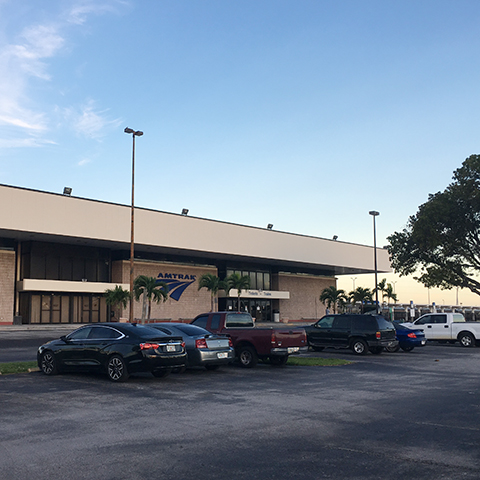
Opened in 1978 in the Hialeah area, the Miami station was built to a standard Amtrak plan and includes a soaring two-story waiting room, large expanses of glass and a cantilevered roof.
8303 NW 37th Avenue
Miami, FL 33147
Annual Station Ridership (FY 2024): 76,474
- Facility Ownership: Amtrak
- Parking Lot Ownership: Amtrak
- Platform Ownership: Amtrak
- Track Ownership: Florida Department of Transportation
Todd Stennis
Regional Contact
governmentaffairsnol@amtrak.com
For information about Amtrak fares and schedules, please visit Amtrak.com or call 1-800-USA-RAIL (1-800-872-7245).
The Miami station lies northeast of Miami International Airport in the Hialeah area. A few blocks to the southwest are the Tri-Rail Metrorail Transfer Station and the Metrorail Tri-Rail Station, which allow travelers to easily access Metrorail and Tri-Rail commuter rail. The Amtrak station is also served by Metrobus.
Constructed at a cost of $5.7 million, the Miami station opened in June 1978 on the site of the old Seaboard Coast Line Railroad yards. Amtrak moved to the new facility from the former Seaboard Air Line Railroad station located at NW 7th Avenue and Perimeter Rd. in the Allapattah neighborhood closer to downtown; this building was subsequently demolished. More than 1,000 people gathered to dedicate the Amtrak station. The first train to depart was the Silver Meteor, which left just before the ceremony began.
Amtrak built the Miami station according to one of a series of standard designs it introduced in the 1970s to help create a brand identity for the new passenger railroad. Design was driven by practical concerns for highly functional, flexible and cost-efficient structures.The Miami facility originally had a twin in the Midway Station, which opened in the same year to serve the cities of Minneapolis and St. Paul.
Rising two stories, the building is composed of textured beige concrete masonry units interspersed with large expanses of glass that allow natural light to flood the interior waiting room. A prominent black metal cantilevered roof caps the station and its deep eaves protect passengers against inclement weather. Viewed at a distance, the roof appears to float above the building due to a band of clerestory windows that follows the top edge of the walls. Inside, a sweeping staircase leads to a raised circular seating area that looks out over the full-height waiting room.
Though native peoples had occupied it for centuries, Europeans first arrived in the Miami area in 1566, when Pedro Menedez de Aviles claimed it for Spain, and a Spanish mission was constructed a year later. In 1836, under American control, Fort Dallas was built and occupied during the fighting of the Second Seminole War.
The city of Miami, as we know it, began with the railroad. Henry S. Flagler’s Florida East Coast Railway (FEC) was supposed to terminate in Palm Beach, which it had reached by 1894. However, with the severe freezes hitting Central Florida in 1894 and 1895, he rethought this decision. It is said that Julia Tuttle, one of two main landowners in Miami (then called Biscayne Bay) sent him a bouquet of orange blossoms to show that her area was unaffected and that her groves were still producing. Tuttle, along with William Bricknell, offered land to Flagler’s railroad in exchange for routing the line through Miami. By 1896, the FEC reached Biscayne Bay, at present downtown Miami.
Flagler further developed the area surrounding the new station by dredging a channel, building streets and the Royal Palm Hotel, instituting the first water and power systems, and financing the town’s first newspaper, the Metropolis. That original FEC station was located near the Dade County Courthouse, and the building was standing as late as 1962. Today, no trace beyond some tracks remains.
Miami has grown very rapidly in the century since its founding, that explosive growth earning it the nickname, “The Magic City.” Miami prospered during the early 1920s Florida land boom, and suffered after a destructive hurricane in 1926 and the Great Depression of the 1930s. During World War II, Miami and the south Florida area played a large role in the battle against German submarines; the war expanded the city’s population considerably by bringing military families to settle there. After Fidel Castro rose to power in 1959, many Cubans came to Miami. Today the city is a major international financial and cultural center and is considered a gateway to South America.
Station Building (with waiting room)
Features
- ATM available
- No elevator
- Payphones
- No Quik-Trak kiosks
- Restrooms
- Ticket sales office
- Unaccompanied child travel allowed
- Vending machines
- No WiFi
- Arrive at least 60 minutes prior to departure if you're checking baggage or need ticketing/passenger assistance
- Arrive at least 30 minutes prior to departure if you're not checking baggage or don't need assistance
Baggage
- Amtrak Express shipping not available
- Checked baggage service available
- Checked baggage storage available
- Bike boxes for sale
- Baggage carts available
- Ski bags not available
- Bag storage
- Shipping Boxes for sale
- Baggage assistance provided by Station Staff
Parking
- Same-day parking is available; fees may apply
- Overnight parking is available; fees may apply
Accessibility
- Payphones
- Accessible platform
- Accessible restrooms
- Accessible ticket office
- Accessible waiting room
- Accessible water fountain
- Same-day, accessible parking is available; fees may apply
- Overnight, accessible parking is available; fees may apply
- No high platform
- Wheelchair available
- Wheelchair lift available
Hours
Station Waiting Room Hours
| Mon | 07:00 am - 07:00 pm |
| Tue | 07:00 am - 07:00 pm |
| Wed | 07:00 am - 07:00 pm |
| Thu | 07:00 am - 07:00 pm |
| Fri | 07:00 am - 07:00 pm |
| Sat | 07:00 am - 07:00 pm |
| Sun | 07:00 am - 07:00 pm |
Ticket Office Hours
| Mon | 07:00 am - 07:00 pm |
| Tue | 07:00 am - 07:00 pm |
| Wed | 07:00 am - 07:00 pm |
| Thu | 07:00 am - 07:00 pm |
| Fri | 07:00 am - 07:00 pm |
| Sat | 07:00 am - 07:00 pm |
| Sun | 07:00 am - 07:00 pm |
Passenger Assistance Hours
| Mon | 07:00 am - 07:00 pm |
| Tue | 07:00 am - 07:00 pm |
| Wed | 07:00 am - 07:00 pm |
| Thu | 07:00 am - 07:00 pm |
| Fri | 07:00 am - 07:00 pm |
| Sat | 07:00 am - 07:00 pm |
| Sun | 07:00 am - 07:00 pm |
Checked Baggage Service
| Mon | 07:00 am - 07:00 pm |
| Tue | 07:00 am - 07:00 pm |
| Wed | 07:00 am - 07:00 pm |
| Thu | 07:00 am - 07:00 pm |
| Fri | 07:00 am - 07:00 pm |
| Sat | 07:00 am - 07:00 pm |
| Sun | 07:00 am - 07:00 pm |
Parking Hours
Quik-Track Kiosk Hours
Lounge Hours
Amtrak Express Hours
| Mon | CLOSED |
| Tue | CLOSED |
| Wed | CLOSED |
| Thu | CLOSED |
| Fri | CLOSED |
| Sat | CLOSED |
| Sun | CLOSED |
 Amtrak established the Great American Stations Project in 2006 to educate communities on the benefits of redeveloping train stations, offer tools to community leaders to preserve their stations, and provide the appropriate Amtrak resources.
 Amtrak is seizing a once-in-a-lifetime opportunity to transform rail and Retrain Travel. By modernizing, enhancing and expanding trains, stations and infrastructure, Amtrak is meeting the rising demand for train travel. Amtrak offers unforgettable experiences to more than 500 destinations across 46 states and parts of Canada. Learn more at